Global growth makes jurisdiction a strategic decision.
In an operating environment defined by uncertainty, founders are placing greater value on jurisdictions that offer stability, investor familiarity and the ability to hire critical talent quickly. When work permits can be secured in days rather than months and governance frameworks are widely trusted by global investors, companies gain confidence to scale without unnecessary friction.
The Cayman Islands has emerged as one such option. For globally minded Canadian entrepreneurs, Cayman offers institutional credibility, legal certainty and operational efficiency, alongside world-class healthcare and a quality of life that supports sustainable growth, while remaining closely connected to North American markets.
This article shares first-hand perspectives from Canadian founders across software, AI, digital assets and Web3 who have established their companies in the Cayman Islands, and why the jurisdiction is viewed as a serious platform for international technology businesses, driven by legal clarity, credibility and long-term operating confidence, not just tax neutrality.
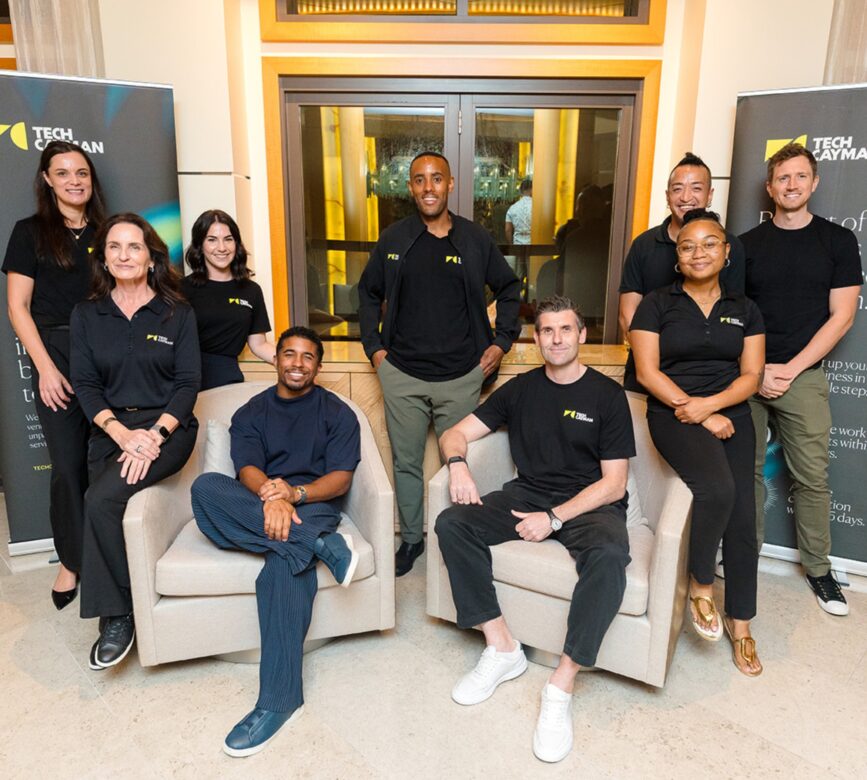
For founders assessing whether Cayman aligns with their operating model, these decisions are often shaped in conversation. Jennifer McCarthy, Head of Client Services and Operations at TechCayman, works directly with founders navigating this transition. Connect with Jennifer on LinkedIn.
Download our eBook: Scaling Smart
Clarity for global tech builders.
TechCayman helps technology and IP-driven companies establish operations in the Cayman Islands, a stable and well-regulated jurisdiction, with clear licensing pathways and work permits approved within 10 business days. By removing uncertainty around talent mobility, founders can hire and relocate key team members quickly while operating within a framework trusted by global investors. Download Scaling Smart to see how the right jurisdiction can accelerate execution and support long-term global growth.
Book a meeting instead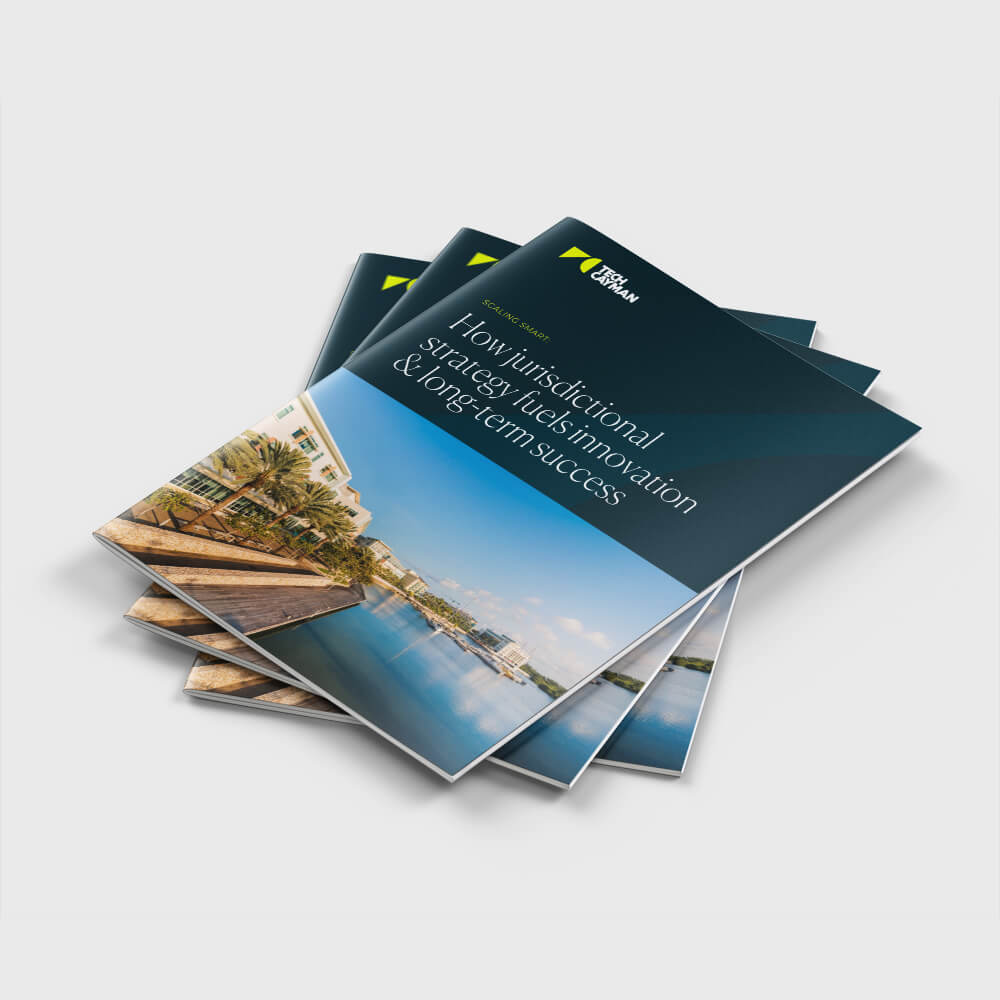
Why globally scaling founders rethink their operating base.
As companies expand across borders, they are increasingly operating within a fragmented global environment. Diverging regulatory frameworks across major markets, from AI governance in Europe to evolving compliance expectations in the United States and Asia, are shaping how technology and IP-driven businesses structure products, manage risk and engage global capital. At the same time, geopolitical uncertainty has elevated the importance of jurisdictional stability, governance consistency and regulatory clarity as companies mature internationally.
Iain Stewart, Canadian founder of Capella Consulting Inc., a digital assets and micro-financing venture he established in the Cayman Islands, explains how global operating realities shaped his decision. “My work is inherently international. As the business grew, I became more focused on finding a base that aligned structurally with how I was actually operating day to day.”
Al Doucet, Canadian founder and CEO of TekToro, reached a similar conclusion as his client base expanded across borders. “My client base had become genuinely international. I was constantly travelling between jurisdictions and realised my business network had grown beyond a single country.”
Why the Cayman Islands stands out for technology and IP ventures.
Cayman’s global reputation has been built on institutional trust. For decades, it has been a leading tax-neutral jurisdiction for international investment funds, supported by a mature ecosystem of global law firms, administrators, auditors and banks. That same foundation now underpins a growing technology and innovation sector, reinforced by purpose-built frameworks such as the Virtual Asset (Service Providers) Act and the Foundation Companies Act, which provide clarity for digital asset and IP-led businesses operating at global scale.
This shift is visible on the ground. According to Dart Leasing, which manages some of the Cayman Islands’ largest commercial developments, technology companies now account for a significant share of new commercial tenants. In Camana Bay alone, tech firms represented roughly half of new office tenants in 2024.
Jennifer Ebanks, Executive Manager of Commercial Leasing at Dart, notes that while Cayman’s regulatory framework often attracts initial interest, it is the strength of the physical environment and professional community that ultimately drives decisions. Founders are often surprised by the depth of Class-A office space, the reliability of infrastructure and the way work, lifestyle and community are integrated into a single operating environment.
For Canadian co-founders Warren Needler and Christy Battell of The Runda Lab, Cayman offered a jurisdiction designed for globally oriented innovation. As their work increasingly intersected technology, IP and Web3, they sought a base that combined international credibility with proximity to North American markets, without adding operational friction.
As we built our venture lab, the path led clearly to the Cayman Islands. From a financial, lifestyle and strategic standpoint, it was the best move we could’ve made.

Operational advantages for globally distributed technology teams.
Beyond regulation, Cayman offers practical operating advantages that matter in execution. Operating on Eastern Standard Time, the jurisdiction enables real-time collaboration with North American clients, investors and partners. Direct flights to Toronto, Panama City, London and major U.S. cities support seamless travel across the Americas and Europe, while modern infrastructure and reliable digital connectivity underpin day-to-day operations.
Access to experienced professional services further reduces friction. Global accounting firms, international law firms and established banks support cross-border structures, IP strategy and compliance, enabling faster decision-making. In a competitive global market for talent, this execution speed becomes a differentiator, allowing teams to form and operate efficiently.
This execution advantage becomes especially meaningful as companies move from strategy to scale.
Quality of life, healthcare and long-term team retention.
Relocation decisions extend beyond business fundamentals. Quality of life, healthcare and the ability to integrate into a community increasingly influence both personal wellbeing and long-term team retention, particularly for founders and senior operators.
The Cayman Islands offers a strong private healthcare system, international education options and safe, welcoming communities. With more than 2,000 registered medical professionals across public and private providers, high-quality care is readily accessible for most medical needs. A consistently warm climate supports year-round outdoor activity and an active daily routine, while access to sport, cultural events and community life helps teams sustain focus and performance over the long term.
For Canadian founders and families, transition is eased by a strong and active Canadian community on island. Direct flights of approximately three hours from Toronto, with regular service from Air Canada, WestJet and Porter, make travel simple. Familiar institutions, cultural traditions and even small comforts from home are readily available, reducing the personal friction often associated with international relocation.
Al Doucet reflects on how this shaped his experience: “What I didn’t anticipate was how much the environment here affects productivity and overall health. You naturally connect with other founders and professionals, and healthcare has been solid. It’s a place where work and life feel genuinely balanced.”
Among globally distributed teams, these factors can be as important as regulatory frameworks in sustaining long-term momentum.

TechCayman: enabling confident global growth from the Cayman Islands.
Establishing a company in a new jurisdiction involves far more than incorporation. Immigration, licensing, office setup and community integration must align to support execution.
TechCayman is a government-enabled service provider that supports global technology and IP-driven enterprises through this process. Through work permits approved within 10 business days, tailored immigration and relocation services, expedited business licensing and flexible office solutions, TechCayman enables companies to become operational with clarity and speed. Beyond initial setup, the team connects founders to a trusted network of professional services, investors and ecosystem partners.
As Jennifer McCarthy, Head of Client Services and Operations, explains, “When immigration, licensing and relocation follow clear pathways, companies can focus on execution rather than uncertainty.”
For the Canadian entrepreneurs behind The Runda Lab, that clarity made the transition far more accessible than expected. “Don’t underestimate how straightforward and beneficial it can be to establish in the Cayman Islands. The process is simpler than you think, and the opportunities speak for themselves.”
contact us
Start the Conversation.
Related Articles
Explore more insights on the latest news and tech trends in the Cayman Islands.