
Venture outlook
Redefining investor value.
Venture capital is entering a more disciplined phase. Investment is stabilising, but access is more selective. Fewer firms now control larger pools of capital, with sharper focus on execution, governance and long-term positioning. As venture becomes more network-driven and specialised, jurisdictions that sit at the intersection of global capital, regulatory clarity and experienced service ecosystems are becoming increasingly relevant. The Cayman Islands has long served as infrastructure for cross-border investment funds, family offices and institutional capital and that same capital network is now intersecting more directly with technology, innovation and globally distributed founders. As Chris Lyons, President of Web3 Media at a16z (Andreessen Horowitz), observed at a recent TechCayman Innovator Insights session, “Money doesn’t differentiate a VC anymore. Services and specialised expertise do.”
2025 venture capital market recovery: trends and insights.
The global venture market has regained momentum following a period of valuation resets and reduced liquidity. Global startup funding rebounded sharply in 2025, up 30% from the year prior and marking one of the most active investment periods since the 2021 peak. Much of this capital flowed into large, late-stage transactions, particularly in AI and infrastructure-heavy businesses, while early-stage deal counts declined by 5% year over year (WIPO, 2026).
This rebound has not been evenly distributed. More than a third of all venture capital went to just 68 super-sized rounds over $500 million (Crunchbase, 2026). Capital is increasingly concentrated among established firms and repeat founders with strong technical defensibility and operational maturity. Venture capital is not simply recovering from a downturn. It is restructuring around risk discipline, scale readiness and long-term value creation.
Why specialised venture funds are gaining ground.
A defining shift in venture over the past three years has been the rise of specialised funds. While generalist capital still plays a role, founder preference has tilted toward investors with deep domain knowledge and relevant operating context. This trend reflects a growing desire for alignment, not only on strategy, but on shared understanding of the markets being served.
As Lyons put it, “Founders don’t want to teach a VC why the market matters.” They’re looking for partners who bring informed conviction and operational fluency from day one. The launch of a16z’s $1.25 billion American Dynamism fund in late 2025 is one such example, targeting areas like AI infrastructure, defence tech and public systems — categories where sector expertise and national relevance intersect (Crunchbase News, 2025).
Crypto in 2025: from speculation to infrastructure.
The crypto market of 2025 was defined less by speculation and more by financial infrastructure. Stablecoins accounted for roughly 30% of all crypto transaction volume, with the monetary base growing by approximately $100 billion to reach $308 billion by year-end (CoinDesk, 2025). Stablecoin usage became increasingly integrated into global payment flows.
This shift was reinforced by policy breakthroughs like the U.S. GENIUS Act, which laid the groundwork for regulated, bank-issued digital dollars. As oversight matured, so did institutional participation. For founders building at the intersection of finance and technology, 2025 marked a shift in expectations. Crypto infrastructure continued to mature into a more dependable layer for global-scale products and new ventures were increasingly evaluated by the resilience and utility of the systems they delivered.
Money doesn’t differentiate a VC anymore. Services and specialised expertise do.

Why AI agents need decentralised infrastructure to scale.
Artificial intelligence is not only attracting capital, it’s transforming economic infrastructure. In 2025, AI startups raised $211 billion globally, an 85% increase year-over-year (Crunchbase, 2026).
As AI evolves from tools to autonomous agents, decentralised protocols are becoming critical to enable identity verification, transaction execution and workflow coordination at machine speed. Venture leaders including a16z view this convergence of AI and decentralised infrastructure as a foundational investment shift (a16z, 2025). Lyons described the convergence of AI and decentralised protocols as a structural reset, already influencing capital deployment. “These systems need rails that can support autonomy. And autonomy requires coordination, not just computation,” he said.
How founders can navigate the future of venture capital.
As these dynamics reshape global venture, founders are recalibrating where and how they build. The next decade of venture will be shaped by the interplay between specialised knowledge, decentralised infrastructure and AI-driven automation. Leading venture firms are repositioning to reflect these dynamics and ecosystems that support global founders are evolving in parallel.
Founders navigating this environment need jurisdictions that offer clarity, reliability and international reach. They need environments where global teams can operate efficiently, where regulatory frameworks are stable and where networks can be built across borders. Cayman offers a jurisdiction designed for global business, supported by an increasingly connected community of innovators.
Lyons framed the founder challenge in simple terms: “You’re not just choosing investors anymore. You’re choosing the networks, jurisdictions and frameworks that will shape how your company grows.” The implication is clear, strategic alignment goes beyond capital to include location, talent and regulatory foundation.
Where global innovators are headed next.
Venture capital is not simply recovering from a cycle. It is shifting to meet the demands of a new decade of innovation. Specialised expertise, cultural influence, AI infrastructure and decentralised rails are becoming core to how companies scale and how investors create value. For Cayman, this moment underscores the relevance of its capital ecosystem as a foundation for long-term innovation. Founders who understand these shifts will be better positioned to navigate emerging markets and build resilient global businesses. If you are exploring how jurisdictional strategy, regulatory clarity or global connectivity fit into your company’s next chapter, our team is here to help. Reach out to continue the conversation at [email protected]

About Innovator Insights.
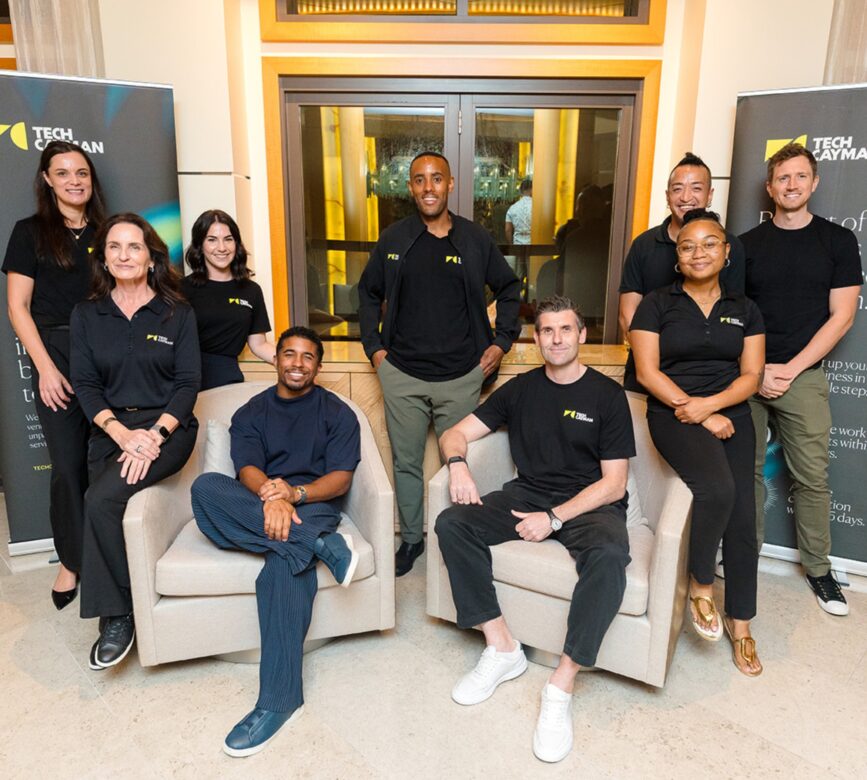
Innovator Insights is TechCayman’s private, invite-only series that brings together global thought leaders, founders and industry experts for candid conversations on technology, leadership and the future of innovation. Sessions are informal and interactive, offering direct access to the people shaping tomorrow’s technologies. Beyond content, Innovator Insights builds the relationships and density that strengthen innovation ecosystems. To learn more about Innovator Insights, get in touch.
CONTACT US
Explore your next chapter in Cayman.
Case Studies
Discover how tech thrives in Cayman with the support of TechCayman.