Exploring responsible AI adoption in the Cayman Islands.
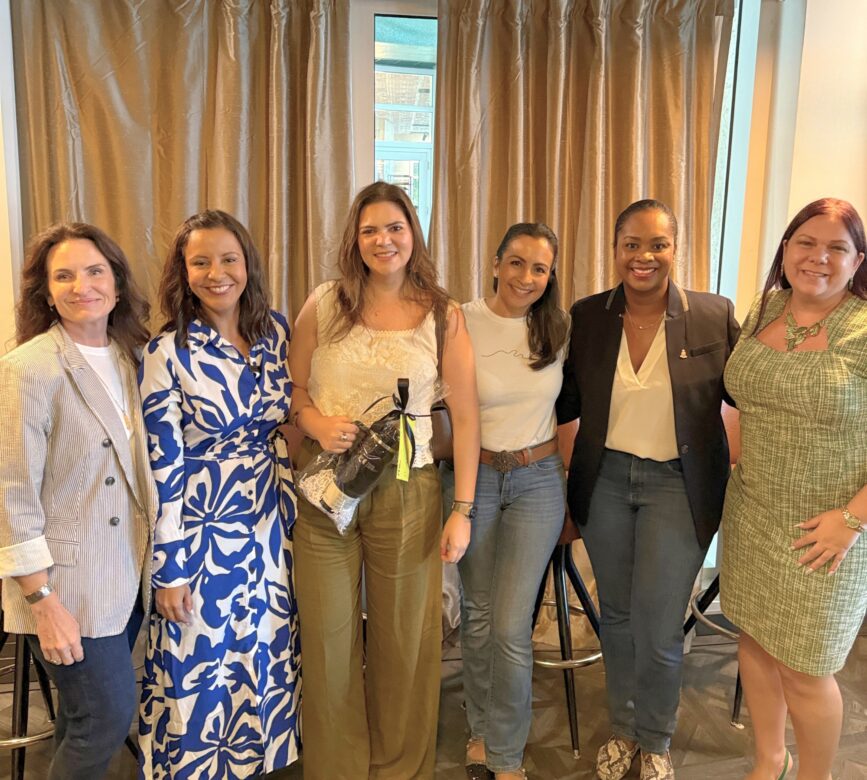
When Story Studio Pro partnered with TechCayman to host the Cayman Islands’ first Women in AI Fireside Chat, organisers anticipated strong interest. We didn’t expect the scale of curiosity, from newcomers to more seasoned adopters of Artificial Intelligence (AI). The September gathering at Union Grill in Camana Bay drew leaders from government, business and technology for a practical, ethical and community-driven discussion on AI.
The event reflected Cayman’s growing engagement with AI, a reality now shaping how organisations operate and how individuals think about the future of work.
Below, we share some of the key takeaways from the event, conversations that bridged experience levels and industries, offering insight for anyone exploring what responsible AI adoption can look like in practice.
Moving beyond the AI hype.
Cristina Spratt, Principal Consultant at Tidal Edge Consulting, set the tone early. “AI adoption is not a sprint, it’s a marathon. One that must start now.” Too many organisations, she warned, treat AI as a quick-fix productivity upgrade. In reality, implementation is a gradual, iterative process that demands experimentation, governance and patience. Inaction, however, carries its own risk. “If you don’t start it now,” she added, “your competitors already have.”
Oneisha Richards, Director of Communications for the Cayman Islands Government, illustrated what that looks like in practice. Her team has been experimenting with AI tools since 2018, using them to analyse sentiment, generate creative assets and streamline campaigns. But, she stressed, “We don’t think AI is going to replace people. It has to be human-centred.” Every output still passes through a human checkpoint.
The government’s approach, cautious yet progressive, embodies a core principle echoed throughout the afternoon: AI should enhance human capability, never replace human judgment.

Three guardrails for practical AI adoption.
For newcomers unsure where to begin, Spratt offered three guardrails that apply to any context:
- Secure your data. Before uploading information, ask whether you’d post it publicly. If not, mask it. The goal is contextual learning, not data exposure.
- Validate the output. AI can be “confidently wrong”. Treat it like an eager junior colleague: review everything before it reaches a client or the public.
- Measure the value. If a tool doesn’t save time, improve quality or reduce cost, it’s not worth keeping.
Lucia Gallardo, founder of Emerge and AeraTech (a TechCayman-sponsored enterprise), added a fourth lens, understand the tool itself. Having caught language models fabricating statistics with absolute certainty, she reminded the audience that systems are optimised to agree, not to challenge. Validation means interrogating the source, not just the sentence.
The human side of AI adoption.
The most candid insights focused not on algorithmic risk but on human psychology. “Most people aren’t afraid of the technology,” Gallardo observed. “They’re afraid of how much learning they have to do.” That anxiety, she suggested, mirrors the paralysis often seen in climate change debates, problems feel too large to influence, so people withdraw. The antidote is incremental participation: breaking the change into digestible actions.
Moderator Lissette Anez, founder of Story Studio, noted another emerging risk, the dilution of quality. When content creation becomes effortless, the digital sphere fills with mediocrity. Platforms like YouTube have already announced algorithms favouring verified human content. “The industry likely to grow most after this wave,” Anez remarked, “is in-person events.” As more processes become automated, authenticity becomes scarce, and therefore valuable.
How to start with AI & build for the long term.
Practicality grounded the discussion. Spratt’s advice to first-time adopters was simple: choose a tool and test it. Decide why you’re using it, what data it touches, and how you’ll judge success. Then reflect, keep what adds value, discard what doesn’t.
Anez shared how documenting internal workflows transformed her agency’s operations. “Before integrating AI, we had to understand our own processes,” she said. Mapping daily tasks, calculating hours and identifying repetitive work revealed where automation could genuinely help.
Gallardo recommended combining self-hosted AI models (often referred to as private GPTs) with automation connectors like Zapier, Make or ClickUp to improve efficiency without compromising security. Not every dataset or workflow belongs in a public model.

Teaching critical thinking in an AI era.
The conversation inevitably turned to the next generation. The panel agreed that parents and educators don’t need to master every new tool, they need to champion critical thinking.
“Critical thinking is a human factor,” said Spratt. “If you’re concerned about what your children need to be doing, enhance that.” Gallardo added that children will adapt to technology naturally. The greater challenge is teaching them agency. “Just because AI says something confidently doesn’t make it true.”
Richards echoed this with a practical approach: when her children use AI for homework, she asks what prompts they used, what sources they verified and who else they discussed it with. The aim is to keep human dialogue and evaluation alive in a digital world.
Preparing the next generation for this reality requires more than awareness, it demands access to opportunities that build digital confidence and curiosity from an early age. TechCayman’s education initiatives, from programming workshops to robotics camps, alongside other local STEM programmes like Code(Cayman), Minds Inspired and 345 Robotics, are helping to meet that need. Together, they are fostering early digital fluency and a mindset grounded in creativity, ethics and critical thinking — the essential foundations for a resilient, future-ready Cayman.
Cayman’s national momentum on AI.
Cayman’s progress is no longer theoretical. The Ministry of Social Development and Innovation is finalising an AI framework, while government departments are already deploying tools within defined guardrails.
In October 2025, the government launched a National Digital Transformation Strategy Taskforce. The group is tasked with delivering guidance across three pillars: digital trust, intelligence and transformation, and digital assets and economic growth. This initiative underscores that AI is a key part of Cayman’s digital transformation agenda.
Gallardo framed the broader question succinctly: every jurisdiction must decide where it sits on the adoption spectrum. Will it be a passive recipient, a user, a trainer or a builder? Cayman’s trajectory suggests a fifth category, a collaborator, applying global insights through local values.
Continuing Cayman’s conversation on AI.
The afternoon ended not with certainty but with momentum. The event demonstrated that a small jurisdiction can lead global conversations when it treats innovation as both a social and a technical endeavour.
The follow-up session in November extended this dialogue, examining how AI is reshaping work, education and creativity across the island. Two Taskforce members, Lucia Gallardo and Tamsin Deasey-Weinstein, offered more insight into Cayman’s structural approach.
If Cayman’s momentum proves anything, it is that progress depends less on scale and more on intention. Responsible adoption begins not with algorithms, but with people willing to ask better questions.
contact us
Thinking about an AI startup?
Related Articles
Explore more insights on the latest news and tech trends in the Cayman Islands.